
Student Spotlight: Casey Dresbach

Miami Waterkeeper student, Casey Dresbach, recently completed her Honor’s thesis with the University of Miami Rosenstiel School of Marine and Atmospheric Science and participated in a poster session where she described her project. Casey used ArcGIS to study Brownfields within Miami-Dade County. Casey’s project, titled: “A Case Study: Prioritizing a Contaminated Brownfield Site within Miami-Dade […]

Back

Miami Waterkeeper student, Casey Dresbach, recently completed her Honor’s thesis with the University of Miami Rosenstiel School of Marine and Atmospheric Science and participated in a poster session where she described her project. Casey used ArcGIS to study Brownfields within Miami-Dade County.

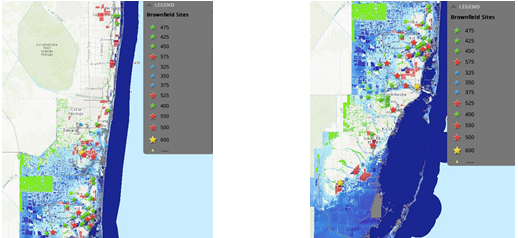
Casey’s project, titled: “A Case Study: Prioritizing a Contaminated Brownfield Site within Miami-Dade County in Overtown, FL for Cleanup, Redevelopment, and Remediation,” evaluated which brownfield sites in Miami were most susceptible to sea level rise and flooding impacts. She cross-referenced these sites with socioeconomic data to determine community vulnerability to potential toxic contamination and compiled this information into a GIS database. The variables she used included: population density, percentage of people below poverty, percentage of people receiving food stamps, disabled individuals, individuals that have received a bachelor’s degree, individuals that have completed high school, employment rates, median income, and environmental hazards.

After her analysis, Overtown, FL was selected as a case study location for possible brownfield redevelopment. Casey’s ArcGIS analysis showed sea-level rise in combination with socioeconomic variables to determine correlation with the vulnerability of brownfield sites. Casey’s study determined that public-private partnerships are essential to brownfield redevelopment, especially in low wealth areas that feel the disparate impacts of climate change. 

For her work, Casey received departmental honors and the University of Miami’s 2019 Outstanding Marine Affairs Student Award. You can read Casey’s full thesis HERE and take a closer look at her poster HERE

Casey’s work will support a collaborative effort among Regional Planning Councils and other stakeholders to secure support for South Florida from the EPA’s Brownfields Assessment Grant program. Thank you for your great work, Casey!

Originally published at https://www.miamiwaterkeeper.org/student_spotlight_casey_dresbach

Tags:

Get updates about our work

We respect your privacy.

Media Coverage

Stories of Accountability & Recovery

Miami Waterkeeper has been cited by local and national outlets as a trusted source on South Florida water quality, policy, and environmental justice.

The Washington Post

An Army Corps project could wipe out one of Florida’s last thriving coral reefs

March 1, 2026

The Washington Post ran an in-depth feature on the U.S. Army Corps of Engineers’ plans to dredge and widen the shipping channel at Port Everglades —…

Read more

Nautical Voice

Concerns Rise Over Port Everglades Expansion’s Impact on Coral Reefs

January 19, 2026

NV Tech Desk reported on the scientific alarm surrounding the Port Everglades expansion, highlighting a landmark study by NOAA and the Shedd Aquarium that…

Read more

The Invading Sea

Trashing our oceans: Feds plan the biggest permitted coral destruction in US history

January 8, 2026

The Invading Sea, Florida’s dedicated climate journalism outlet, published a stark account of what the Port Everglades dredge proposal actually entails: 400 underwater acres…

Read more

Support our work

We’re committed to transparency, accountability, and maximizing the impact of every dollar entrusted to us. Be part of the change and donate today!

Florida Solicitation of Contributions Registration #CH46021 A copy of the official registration and financial information for Biscayne Bay Waterkeeper (aka Miami Waterkeeper), a Florida-based nonprofit organization, may be obtained from the Division of Consumer Services by calling toll-free 1-800-HELP-FLA (435-7352) within the state or visiting www.800HELPFLA.com. Registration does not imply endorsement, approval, or recommendation by the state.