
The Environmental Protection Agency’s (EPA) Brownfields Program empowers states, communities, and other stakeholders to work together to prevent, assess, safely clean up, and sustainably reuse brownfields. A brownfield site is a property through which the expansion, redevelopment, or reuse may be complicated by the presence or potential presence of a hazardous substance, pollutant, or contaminant.
The EPA provides financial assistance to eligible applicants through five competitive grant programs: multipurpose grants, assessment grants, revolving loan fund grants, cleanup grants, and environmental workforce grants.

The EPA has selected the Treasure Coast Regional Planning Council (TCRPC) for a Brownfields Assessment Coalition Grant. These funds will be used to conduct environmental site assessments of brownfield locations in South Florida, including Southern Miami-Dade County. Grant funds will also be used to develop 10 cleanup plans and 5 site reuse assessments, create a GIS-based site inventor, and conduct community redevelopment areas in several cities in South Florida. Miami Waterkeeper is a coalition partner for this project, along with the South Florida Regional Planning Council.
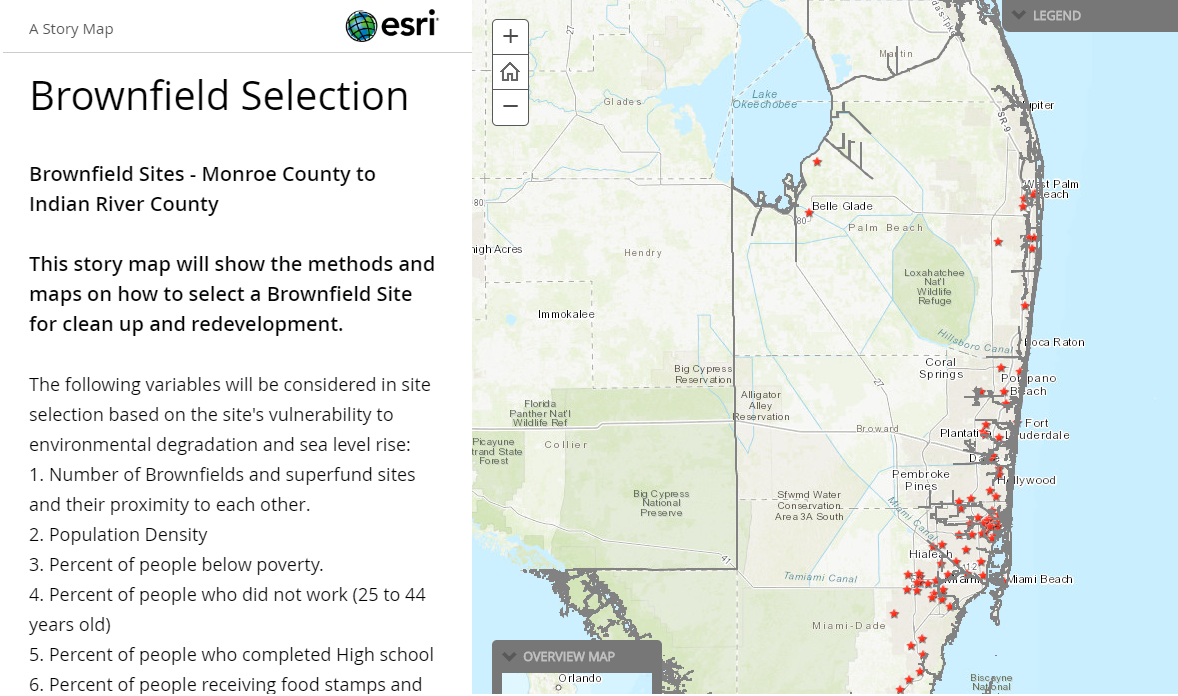
Our work in this coalition is supported through student Casey Dresbach’s work. She completed her honor’s thesis at the University of Miami where she used ArcGIS to study Brownfields within Miami-Dade County. She evaluated which brownfields were most susceptible to sea level rise and flooding impacts, then she cross-referenced those sites with socioeconomic data to determine community vulnerability to potential toxic contamination and compiled this information into a GIS database. Click HERE to view the GIS tool.
We are very excited to see Casey’s work influencing practical measures to address flooding and potential contamination of waterways in Miami-Dade County! We look forward to working together with the Regional Planning Councils on this effort moving forward. You can read the full announcement here.
Support Us!
Interested in supporting our work for clean water in South Florida? Consider becoming a sustaining member or donate today!
Originally published at https://www.miamiwaterkeeper.org/brownfield_assessment_grant_to_address_flooding_in_south_florida